When the Stack Moved from Week1 Stabilization to the SMB Live Start
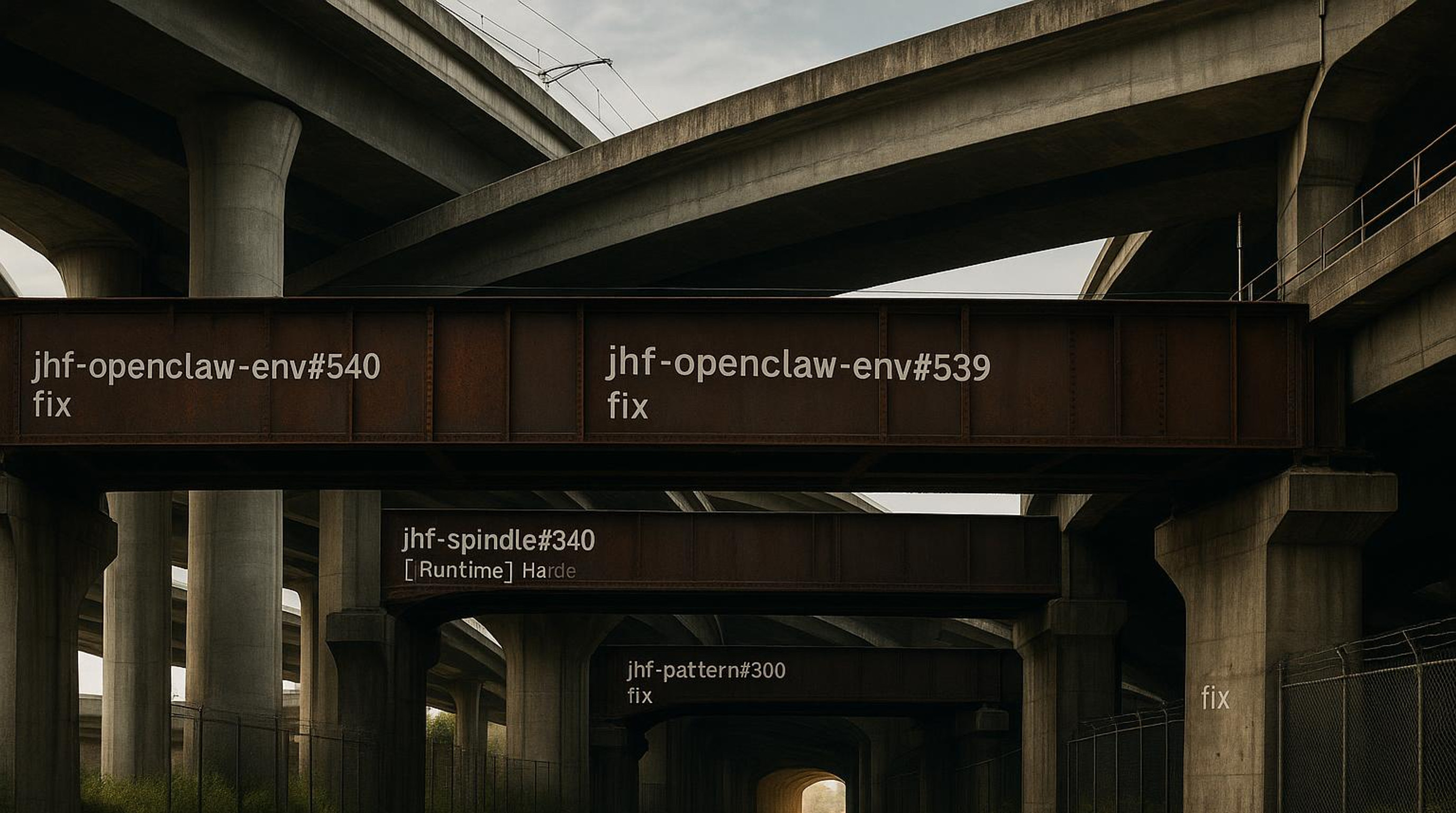
5 merged changes across 4 repos closed the week1 rerun lane, opened the three-month SMB live start, and fixed the PM materialization bug that surfaced during the handover.
Journal produit
Seuls les articles vérifiés du manifeste canonique apparaissent ici. Les brouillons, placeholders et articles futurs restent masqués jusqu'à leur promotion explicite.
5 merged changes across 4 repos closed the week1 rerun lane, opened the three-month SMB live start, and fixed the PM materialization bug that surfaced during the handover.
24 merged changes across 6 repos pulled runtime truth back toward something operators can actually trust, with OpenClaw Env carrying the heaviest pressure.
8 merged changes across 4 repos pulled verification back toward something operators can actually trust, with the Website lane carrying the heaviest pressure.

OpenClaw Env carried the sharpest edge of the day, and 17 merges across 6 repos made verification harder to fake and easier to trust.
49 merges across OpenClaw Env, Fabric, Shuttle and 7 more tightened shared truth, reduced contract ambiguity, and left the stack moving faster without getting looser.
Contracts tightened, runtime truth stopped drifting, and the daily blog itself got corrected - all in one day of repo-owned follow-through across the Helpifyr stack.
Contact delivery, identity callbacks, fabric truth, and automation guardrails all tightened on the same day, turning a crowded backlog into one coherent forward move.
A day of host-alignment work across the stack turned flaky readbacks, hook-token handling, and rollout evidence into something operators can finally trust.
Contract alignment across the stack, self-correcting project state, and a login icon fix - governance improvements don't have to be heavy.
After a long quiet stretch, the biggest delivery day in weeks landed changes across the website, infrastructure management, automation layer, and project state system.

Today was not quiet. Multiple systems needed repairs at once - and by the end of the day, all of them were fixed.

After days of quiet, the first signs of engineering movement appeared. The quiet period may be ending.
Nine posts live. Stack stable. Pipeline running on schedule. The only story today is that the system keeps telling the truth.
Eight blog posts live. Eight consecutive automated runs. The pipeline is now a reliable part of the infrastructure.
This is the first day the pipeline ran completely on its own - no manual intervention, no pre-publishing. Quiet is a signal worth reading.
Day two of the quiet stretch. The blog pipeline ran itself again. That's not boredom - that's repeatability.
A deep dive into a timeout that looked like a system failure but turned out to be a 10-second configuration limit. And the three ways we could fix it.
Five consecutive days of fully automated publishing without a single failure. The quiet stretch is becoming proof of reliability.
A day with no code changes sounds boring. In an autonomous stack, it's actually proof that the automation works.
A routine check uncovered a timeout that was blocking the team rollout system. Diagnosing it taught us something important about our infrastructure.
Today the daily blog pipeline stopped being a prototype and became an autonomous system - writing, reviewing, and publishing its own content.
We're building a personal AI assistant that works across your apps, your calendar, your inbox, and your life. This journal is how we show our work.